


08 Jul Thinkpiece
In this update:
- Financial Success
- Corrections
- Bull and Bear Markets
- Volatility
- Inflation
- Remember your objectives
- Market Timing
- How successful investors respond
Financial Success
Financial and investing success are behavioural.
Understanding your reaction to events, not the events themselves, is essential. How you respond during different market events, is important.
All financial success comes from acting on a plan. A lot of financial failure comes from reacting to the market. Put that on my tombstone! It’s the mega-truth.
Nick Murray
Market Corrections
History tells us that market corrections occur once a year. A correction is defined as a fall of more than 10%, but less than 20%, from the previous market high.
They average a fall of around 13%, yet they are often over so quickly that we don’t notice them.
Bull and Bear Markets
Where a market correction continues and markets fall more than 20% from their previous high, this becomes a bear market. 1 in 5 corrections become a bear market.

Bear markets occur on average 1/4 of the time. The opposite, a bull market, occurs on average 3/4 of the time.
A bull market is defined as a rise from the previous market low, by greater than 20%.
Time and again as an investor, your ability not to react to temporary market declines will be tested.
That’s why, if you lose patience with the market, you’ll give your investments back to the waiting investors that will ultimately benefit from your decision.
In bear markets, stocks return to their rightful owners.
J P Morgan
Inflation
Current inflation has been caused by, among others:
- Supply chain disruption following Covid.
- Money that central banks have printed during Covid – Furlough schemes etc.
- That money was largely saved by people ‘working from home’.
- Now that lockdowns are largely over, people decided to spend that extra money, but there are limited services, and very limited skilled service and tradespeople.
- Volatility in the world – the Ukraine / Russia War, has helped to push up oil and gas prices.
This is a perfect storm for higher inflation.
Inflation is far less threatening than the prospect of recession or slow growth, and raising interest rates to dampen inflation offers a cure that is often far worse than the disease.
Higher levels of inflation will persist where wages increase significantly. The concern about inflation is not so much as to where it is now, although that is difficult to bear, but where it falls to when it does begin to come down.
Remember that it is still the aim of central banks (The Fed, Bank of England, European Central Bank etc.) to keep inflation below 2%.
Volatility
Markets abhor uncertainty. There is plenty of uncertainty currently. However, markets climb a wall of worry. They always have.
There have been plenty of reasons to sell your investments over recent years, but history tells us to stick with our original plan. Selling our investments during market turmoil, which is a normal occurrence 1/4 of the time, is usually not in your best interests.
As yourself what in you is driving your decisions – your emotions, or your logic?
A lot of people with high IQs are terrible investors because they’ve got terrible temperaments. You need to keep raw, irrational emotion under control.
Charlie Munger
At the present time, markets cannot price the value of the world’s greatest businesses, because they don’t yet know how the impact of higher inflation, and other global events, will impact upon their future earnings.
In the short term, the stock market is irrational. That’s just the way it is. In the longer term, the stock market is a weighing machine, and it weighs company earnings. A company’s share price will fluctuate based on its outlook for earnings.
This increase and decrease in the short term causes volatility, which is the unpredictability of prices.
Volatility is the price of admission.
Morgan Housel
Don’t allow volatility to make you forget your objectives. There have been plenty of reasons to sell your investments, with markets soaring one moment and swooning in another, though always around a constantly rising trendline.
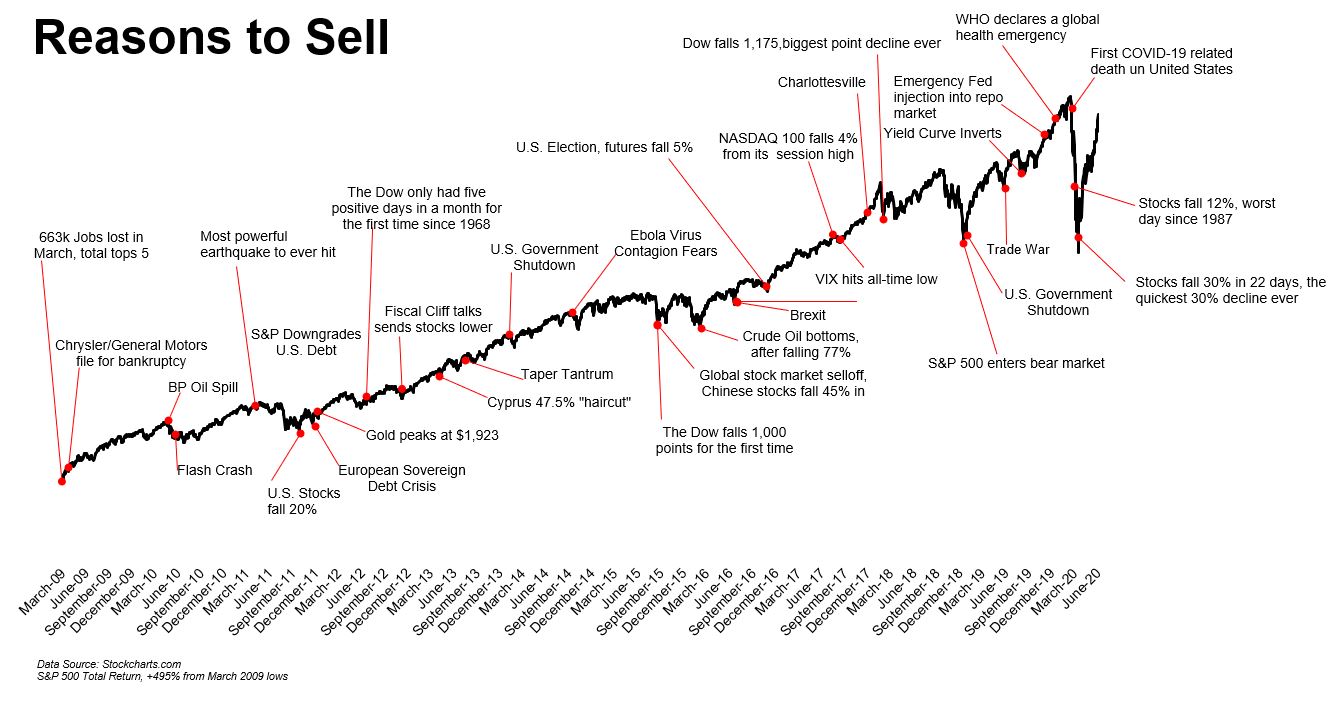
It was why Sir John Templeton explained the following:
‘This time it’s different’– the four most expensive words in the English language
Sir John Marks Templeton
Globally, it is different, but economically it’s the same as it ever was. Nothing that is happening now, hasn’t occurred in markets before. Bear markets come and go. It’s how you respond that matters.
If you’re tempted to bail out, history tells us that you’ll likely act against your own best interests. In fact, if you have surplus funds above your designated emergency fund and short term cash reserves, one could argue that it’s a good time to buy. However, your emotions may rise again:
When the time comes to buy, you won’t want to.
Walter Deemer
This is why financial and investing success is behavioural. Don’t let your emotions run the show.
The difficulty comes in that we will undoubtedly have our own life agenda, right now, that we are trying to achieve. The market does not know that you own it, and its path is not in timing with our own agenda.
No matter how good one’s investment process is, how well designed the allocation is to numerous high quality profit producing companies, negative systemic world events will always override all strategies……………..but only temporarily!
I say it a lot, but markets climb a wall of worry. That’s just how it is. When that worry is heightened by significant levels of uncertainty, volatility is increased.
Volatility however, is not loss.
A quality company, trading in profit, with demand for its services, does not suddenly become a poor company overnight due to unpredictable world events.
Therefore, the market will get the pricing of companies wrong. It is imprecise, and certainly at the moment, you’re not going to get an accurate reading of the true value of your investments.
Mr Market’s job is to provide you with prices; your job is to decide whether it is to your advantage to act on them. You do not have to trade with him just because he constantly begs you to.
Benjamin Graham
Remember your Objectives
It’s human nature and entirely understandable to want to move our money into supposed ‘safe’ havens, like cash.
….but stick to your plan. What was the reason you invested in the first place? What were your objectives?
A knee jerk reaction now is not going to help those long terms plans you made. Don’t be tempted, no matter how strong the pull is. Your future self will not thank you for reacting in this way. Your future self will thank you for responding appropriately. There’s a big difference.
The Stock market is a story.
When the story changes, the price changes.
How successful investors respond
The answer then is to stick to the plan.
This is all part and parcel of working with your financial planner and comes built as standard.
Summary
- Don’t assume that volatility is a bad thing. Volatility is perfectly normal. The market isn’t broken.
- Don’t let short term noise inform your long term planning. Remember your objectives – Stick with your long term plan!
- Don’t be tempted into thinking that you can time the market. You can’t!
- Reduce or stop withdrawals from your portfolios until markets recover. Then restart withdrawals if you need to.
- Reduce discretionary spending if you have to. Your future self will thank you for it.
- Use your emergency / cash fund until markets recover.
In investing, what is comfortable is rarely profitable.
Robert Arnott
If you’ve not yet put in place a sound financial plan and you’d like to know more, please feel free to contact us on
01626 305318 or via email here.
The views expressed are not to be taken as financial advice. Professional advice should be sought before proceeding.
Sorry, the comment form is closed at this time.